

By Elie Dufeu, CTO & Co-Founder, Metreecs. Published 22 October 2026.

Forecasting predicts a number. Demand planning turns that number into a decision the business can execute. If you need a statistical baseline of expected demand, that's forecasting. If you need cross-functional alignment, documented assumptions, and a plan supply chain can commit to, that's demand planning.
Use forecasting when you need the raw math: a MAPE-scored, model-generated baseline. Use demand planning when you need consensus across sales, finance, and operations before that number becomes an S&OP or IBP commitment. Practices like Forecast Value Add help you tell whether the planning layer is actually improving on the statistical baseline or just adding noise.
- Forecasting = quantitative prediction, statistically driven
- Demand planning = cross-functional process, consensus driven
- Both feed the same S&OP/IBP cycle, but at different stages
For a closer look at how an AI-driven baseline plugs into that hand-off, Metreecs' demand planning platform is built specifically for the forecasting-to-planning transition.
Table of contents
- What is demand forecasting and how does it work?
- What is demand planning and who owns it?
- Demand planning vs forecasting: key differences
- How do forecasting and planning fit into S&OP and IBP?
- Who is responsible: demand planning roles explained
- What metrics matter for forecasting vs demand planning?
- Which tools and methods support each process?
- Best practices for demand planning and forecasting
- How is AI changing demand forecasting and planning?
- Frequently asked questions
- Sources
Key takeaways
- Forecasting produces a statistical baseline; demand planning converts that baseline into a cross-functional, executable plan with documented assumptions.
- Constrain supply, not demand, during the review process. That is what preserves root-cause clarity when a forecast misses.
- Track MAPE, bias, and Forecast Value Add for the forecasting layer; track plan adherence, OTIF, and inventory days for the planning layer.
- Organizations that balance demand and supply planning report up to 15% higher forecast accuracy and 35% lower inventory costs, according to Inbound Logistics.
What is demand forecasting and how does it work?
Demand forecasting is a statistical process. It applies time-series models or machine learning to historical data and produces a numeric baseline of expected demand, with no commercial judgment layered on top yet.
Typical inputs include historical sales or shipment volumes, POS data, promotional calendars, pricing changes, and sometimes external signals like weather or macroeconomic indicators. Horizons vary by use: short-term forecasts (days to weeks) support replenishment, medium-term (months) supports S&OP, and long-term (a year or more) supports capacity and financial planning.
Forecasting is repeatable by design. The same data run through the same model produces the same output, which is why statistical forecasting is meant to anchor the demand plan as an objective baseline. Its limitation is equally structural: a model cannot predict an event it has never seen unless that pattern is explicitly built in.
- Moving average and exponential smoothing (ETS) for stable demand patterns
- ARIMA and Prophet for seasonality and trend decomposition
- Hierarchical forecasting for reconciling product, category, and regional views
- Machine learning models for high-variability or promo-heavy categories
What is demand planning and who owns it?
Demand planning is the business process that takes the statistical baseline and turns it into something the organization can act on. It is an end-to-end process that converts a statistical forecast into a consensus demand plan and documented assumptions, built through cross-functional review rather than a single analyst's model run.
The outputs look different from forecasting's outputs. Instead of a single number, you get a consensus demand plan, a living assumptions log, scenario variants for major risks, and formal inputs handed to supply planning and S&OP.
- Consensus demand plan reflecting sales, marketing, and finance input
- Assumptions log documenting every commercial adjustment and its rationale
- Scenario plans for promotions, launches, or demand shocks
- Structured inputs for supply planning and the S&OP cycle
Stakeholders typically include demand planners, sales and marketing leadership, finance, and supply chain. Horizon framing shifts too: short-term demand sensing adjusts execution day to day, the monthly cycle builds consensus, and the long view feeds capacity and financial commitments.
Across Metreecs' work with retailers running multi-location assortments, the consensus meeting is where this breaks down first. Everyone agrees on the number in the room, then quietly reverts to their own spreadsheet the next morning because nobody owns the record of what was agreed.
Sofia runs demand planning for a mid-market home goods retailer with about 40 stores. Her S&OP cycle used to slip by two to three weeks every quarter because nobody owned the assumptions log: sales adjusted the baseline in one spreadsheet, finance kept a different copy, and the two were never reconciled before the meeting. Once she assigned a single owner to the log and required every commercial adjustment to carry a name and a date, the cycle settled back into a two-week cadence, and the November forecast miss that used to trigger a scramble became a five-minute agenda item.
Demand planning vs forecasting: key differences
The clearest way to separate demand planning vs supply planning, and forecasting from both, is to compare them on the dimensions that actually change how you staff and measure the work.
- Primary focus: forecasting predicts a number; demand planning builds an actionable, agreed plan.
- Time horizon: forecasting runs from days to years depending on the model; demand planning centers on the monthly S&OP cycle, with sensing at the daily/weekly edge.
- Inputs: forecasting uses historical data and statistical variables; demand planning adds commercial judgment, promotional intelligence, and cross-functional sign-off.
- Outputs: forecasting produces a baseline number; demand planning produces a consensus plan, assumptions log, and scenarios.
- Stakeholders: forecasting is typically owned by an analyst or data science function; demand planning involves sales, marketing, finance, and supply chain leadership.
- Decision use: forecasting informs tactical, short-cycle decisions; demand planning drives operational and strategic commitments tied to S&OP/IBP.
Every one of these bullets converts directly into a RACI line for an internal memo. The most common failure mode is blending demand and supply too early, letting available inventory quietly shape what gets called "demand." That practice, sometimes called phantom feasibility, only preserves an unconstrained market signal when demand and supply stay separate. Conflating the two erases your ability to tell whether a miss came from a bad demand assumption or a supply constraint.
How do forecasting and planning fit into S&OP and IBP?
Forecasting and demand planning are not competing processes. They are sequential stages in the same S&OP/IBP cycle, and each stage has a different owner and a different level of constraint.
- Statistical forecast generates the unconstrained baseline from historical and external data.
- Demand review layers in commercial intelligence, promotional plans, and market intelligence to build consensus.
- Consensus demand plan becomes the output handed to supply planning.
- Supply review tests that plan against capacity, materials, and lead times.
- Integrated reconciliation (pre-S&OP/S&OP) resolves gaps between demand and supply before executive sign-off.
Cadence matters here. Daily or weekly demand sensing adjusts near-term execution, the monthly demand review builds the rolling consensus plan, and the quarterly or annual IBP horizon feeds capacity and financial commitments. The demand plan should stay unconstrained through the demand review; supply plans are where feasibility constraints belong.
Who is responsible: demand planning roles explained
Ownership gets murky fast without clear boundaries. The statistical baseline typically belongs to a forecast analyst or demand planning function. The consensus demand plan belongs to demand planning, but only with active input from commercial teams. Supply planners own feasibility and execution against that plan.
- Demand planners facilitate the review and maintain the assumptions log
- Sales and marketing own the commercial assumptions driving overlays
- Supply planning owns feasibility checks and execution
- Finance translates the consensus plan into P&L impact
Job postings for senior demand planning roles consistently list forecast accuracy ownership, cross-functional collaboration, new product introduction support, and S&OP facilitation as core responsibilities, not side tasks.
Pro Tip: Assign one person to own the assumptions log across the full cycle. Without a single owner, commercial adjustments get made twice, or not documented at all.

What metrics matter for forecasting vs demand planning?
Forecast accuracy and plan effectiveness are different questions, and mixing their metrics is a common way teams end up measuring the wrong thing.
- Forecast-focused: MAPE or WMAPE, bias, Forecast Value Add, and week-1 accuracy gains from demand sensing
- Plan-focused: plan adherence, OTIF, fill rate, inventory days of supply, expedite spend, and revenue realization against plan
A low MAPE with high bias still misleads planning decisions, since consistent over-forecasting can look accurate on average while quietly building excess stock. Inbound Logistics reports that organizations balancing demand and supply planning see up to 15% higher forecast accuracy and 35% lower inventory costs, a reminder that the KPIs you track for networked inventory should map back to whoever actually owns the decision the metric informs.
Which tools and methods support each process?
The tooling for forecasting and the tooling for demand planning solve different problems, and conflating them is how companies end up with a great model and a broken process around it.
Statistical forecasting methods range from ETS and ARIMA for stable patterns to Prophet and hierarchical models for seasonality, with ML models increasingly used for high-variability categories. Enterprise employers now list proficiency in enterprise planning platforms alongside modern ML models as standard demand analytics skills.
- Short-horizon demand sensing pulls from POS, order flow, inventory position, and external signals
- Planning software runs consensus workflows, assumption logs, and scenario modeling
- Integration layers connect the statistical baseline to ERP and S&OP tools automatically
The practical split: automate the statistical baseline generation, but keep human review on commercial overlays and exception handling. A guide to combining internal and external data shows how far this integration can go before it needs a human check.
Best practices for demand planning and forecasting
- Start every planning cycle from the statistical baseline, not from last year's plan.
- Document every commercial adjustment in the assumptions log, with a named owner.
- Keep demand unconstrained during the demand review; let supply apply constraints later.
- Use demand sensing data to sharpen near-term execution decisions.
- Run root-cause analysis on every significant forecast miss before adjusting the model.
ASCM's guidance on demand and supply planning recommends defining forecasting granularity by country, product, and time period up front, which prevents rework later in the cycle.
One mistake we repeatedly see is a demand planning team measured on hitting a revenue number instead of forecast accuracy and plan adherence, which quietly rewards sandbagging the baseline instead of sharpening it.
Pro Tip: Set demand planning incentives on forecast accuracy and plan adherence, not on hitting a revenue number. Misaligned incentives are the fastest way to get gamed metrics instead of honest forecasts.
How is AI changing demand forecasting and planning?
AI has not replaced the forecast versus plan distinction, but it has sped up the sensing layer and sharpened the baseline feeding into the human-led planning process.
Large consumer goods teams piloting machine learning and demand-sensing approaches still retain human review for commercial adjustments. The inventory cost reductions reported when demand and supply planning are properly aligned come from process discipline as much as model sophistication.
Marcus leads supply planning at a specialty electronics retailer and spent most of last year chasing a forecast that looked accurate on paper but kept missing at the category level. Once his team separated MAPE from plan adherence and reviewed the two metrics in separate agenda items, the root cause surfaced within a month: a regional sales lead had been overriding the statistical baseline by 20 to 30 percent every cycle, with no documented reason in the assumptions log.
- Pilot ML models on high-value or high-variability products first
- Combine the ML baseline with human overlays, never replace one with the other
- Require model governance and clear escalation paths for exceptions
Where a strict rules engine used to run reorder logic, AI agents for retail are increasingly handling the routine exception review that used to fall on a planner every morning.
A leadership priority for the next S&OP cycle
Prioritize separating forecast accuracy metrics from plan adherence metrics this quarter. Mixed KPIs between demand and supply teams are the most common reason S&OP meetings turn into blame sessions instead of decisions.
Frequently asked questions
Is demand forecasting the same as demand planning?
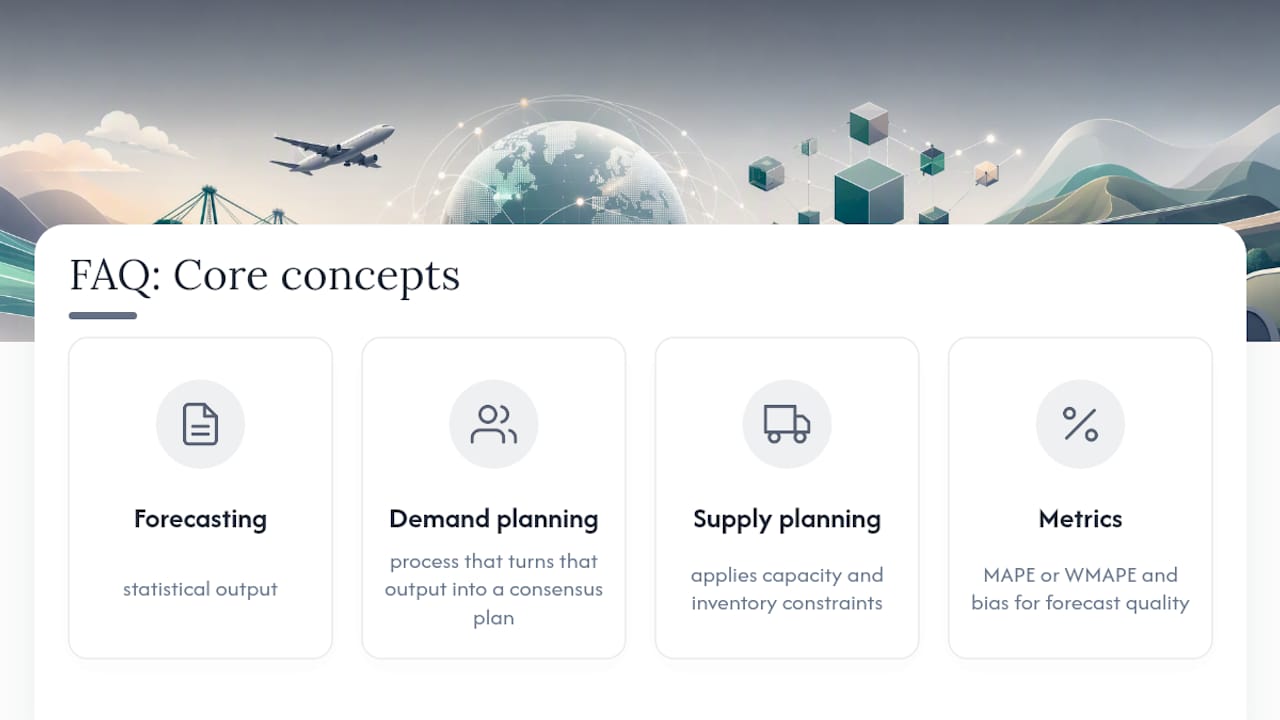
No. Forecasting is the statistical output; demand planning is the process that turns that output into a consensus plan with cross-functional sign-off.
Why is demand forecasting important if planning adds the judgment?
Without an objective baseline, commercial overlays have nothing to be measured against, and bias becomes invisible. The baseline is what makes Forecast Value Add measurable at all.
What's the difference between demand planning and supply planning?
Demand planning stays unconstrained to reflect true market signal. Supply planning applies capacity and inventory constraints to make that signal feasible to execute.
Which metrics should a demand planning team report first?
MAPE or WMAPE and bias for forecast quality, plus plan adherence for how well the consensus plan is actually followed.
Does AI replace the need for a demand planning team?
No. AI accelerates the statistical baseline and demand sensing, but commercial judgment, assumption documentation, and cross-functional consensus still require human ownership.
Conclusion
Forecasting and demand planning solve different problems. One produces the statistical baseline, the other turns it into a plan the business can commit to. Keep the two processes distinct, give the assumptions log a single named owner, and measure each layer on its own metric so a forecast miss and a plan miss never get confused with each other. Book a discovery call to see how Metreecs' AI-driven baseline plugs directly into your S&OP consensus workflow.
Sources
- Demand and supply planning (ASCM): industry guidance on forecasting granularity and planning process design.
- Demand planning vs. supply planning (Inbound Logistics): reported accuracy and inventory-cost impact of aligning demand and supply planning.
Our articles












Own your operations with AI Intelligence
.svg)